|
Haojie Huang I'm an undergraduate student majoring in Artificial Intelligence at Zhejiang University (entered in 2025). Since February 2026, I have been a research intern at the Learning and Vision Lab, National University of Singapore (NUS@LV-Lab), advised by Prof. Shuicheng Yan and Dr. Xiaobin Hu. At LV-Lab, I have also been very fortunate to work with Xinlei Yu and Chengming Xu. |
|
ResearchI'm broadly interested in how vision should be learned, represented, and scaled. I tend to see most problems through representation learning, shaped by three things: the objective, the data, and the architecture. Questions I'm currently working on include: what visual information survives different training paradigms (contrastive pretraining, VLM fine-tuning, native multimodal training); whether pixel-level and semantic objectives can coexist in one representation; and, more recently, how to make vision a first-class citizen in VLM training, one that coexists well with language. |
News
|
Publications |
|
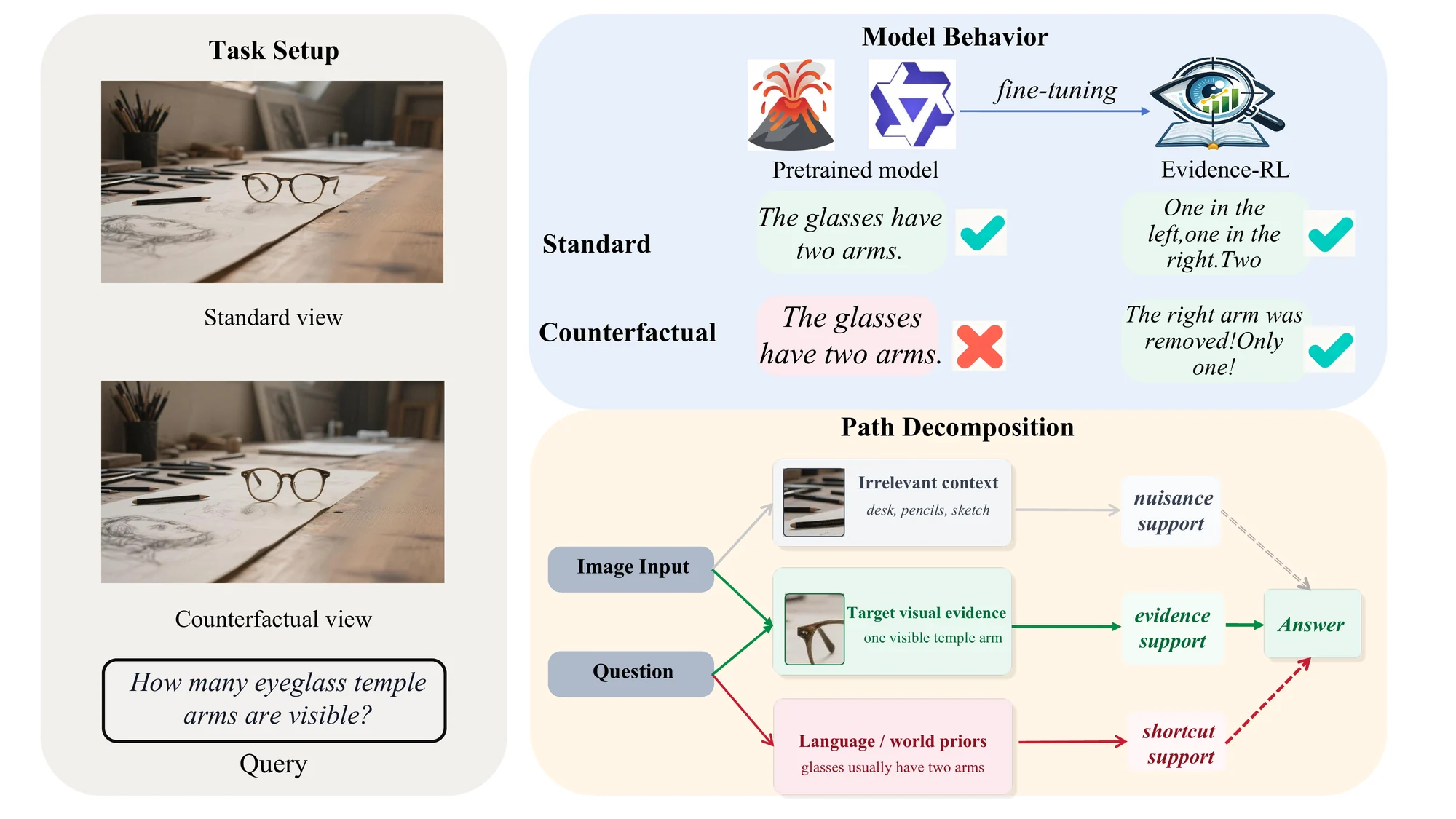
Evidence-RL: Towards Evidence-intensive Visual Reasoning
Haojie Huang*, Xinlei Yu*, Chengming Xu*, Zhangquan Chen, Cheng Yang, Qingdong He, Yu Yang, Jiangning Zhang, Xiaobin Hu† NeurIPS, 2026 project page / arXiv / code / checkpoint Counterfactual Evidence Disentanglement (CED) rewards VLMs during RL post-training only when their answers causally depend on the right visual evidence, improving grounded reasoning across nine benchmarks with no inference-time cost. |

|
The Latent Space: Foundation, Evolution, Mechanism, Ability, and Outlook
Xinlei Yu, Zhangquan Chen, Yongbo He, …, Haojie Huang, …, Shuicheng Yan arXiv, 2026 arXiv / paper list A survey of latent space as a computational substrate for language-based models, organized by foundation, evolution, mechanism, ability, and outlook. |
|
* Equal contribution † Corresponding author |